SEO
 Digital PR
 GEO / AI Search
 Social







The skill behind the framework
A framework is only as useful as the people applying it, and applying this one well requires enough foundational knowledge to make a confident delegation decision.
It’s pivotal that we continue developing our future experts and leaders. How will we decide whether a task belongs to rules-based automation or AI-assisted automation if our team doesn’t understand what the task actually involves? How will we spot a flawed AI output if no one knows what the correct answer looks like? Who will action the ‘keep human’ work if the experience and judgement that makes it valuable has been gradually compressed out of the team by over-reliance on tools?
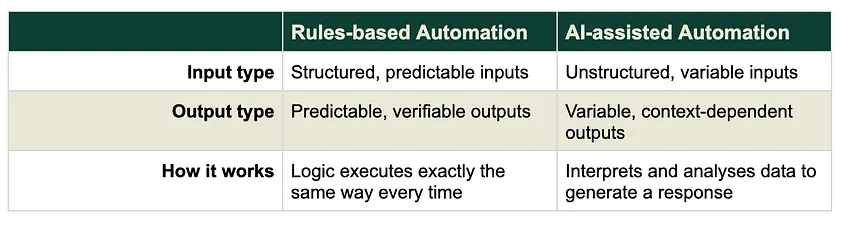
To support our teams further when it comes to AI vs human delegation, which can feel slightly blurrier, every member of the team at Kaizen now holds an accreditation in AI Fluency – part of Anthropic’s course covers delegation to AI tools through three core lenses: problem awareness, platform awareness, and task delegation. After running the first training cohort, we saw a +20.6% uplift in our team’s confidence when delegating tasks between themselves and LLMs, with decidedly less reliance on AI for highly creative tasks. This matters to the clients we work with because there is a meaningful difference between an agency that uses AI and an agency that uses AI deliberately.
HubSpot’s 2025 State of Marketing report found that 92% of marketers say AI has already impacted their roles. This isn’t surprising; AI is a game-changing tool, just like Microsoft Office was when it first landed on the scene, but impact and intentional adoption are not the same thing. Yes, most teams are using AI, but there’s so much to gain from asking the right questions before doing so.
Key Takeaways
- The cost of process-driven work in digital marketing depends on a series of decisions that most teams haven’t made yet
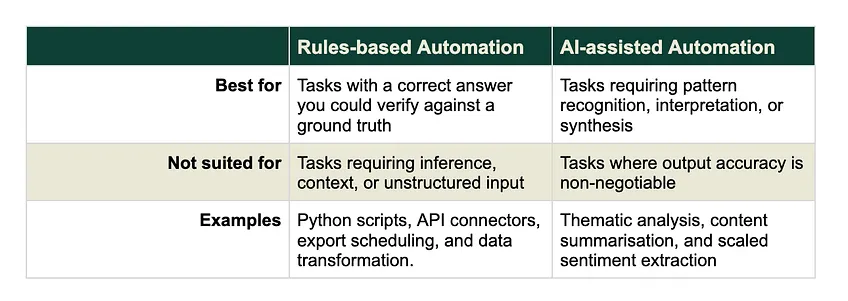
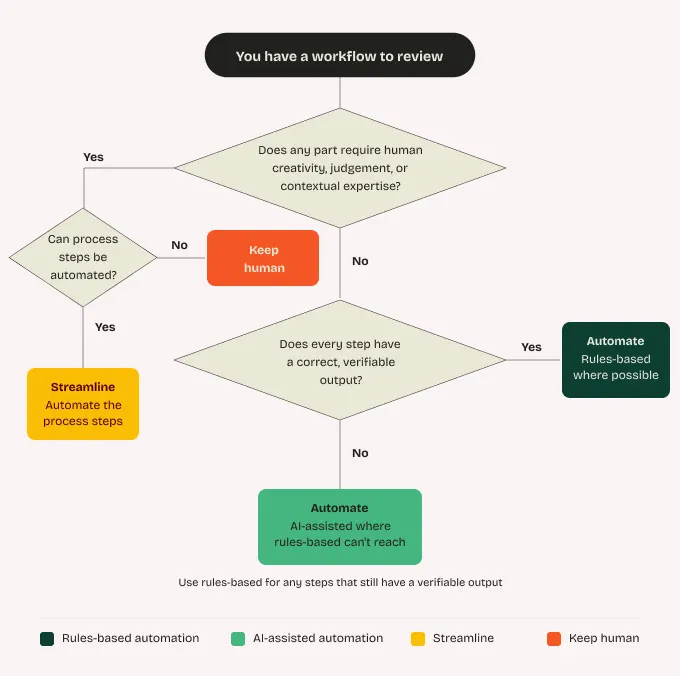
- Before automating anything, ask: Does this task have a correct answer I could verify? If yes, keep it rules-based
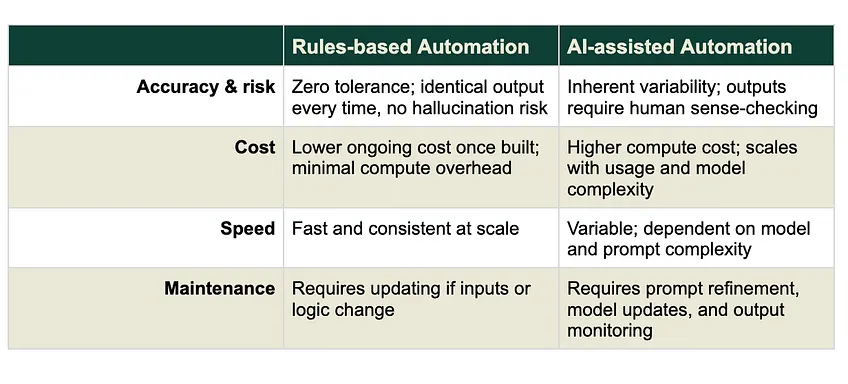
- Rules-based and AI-assisted automation are not interchangeable – defaulting to AI where deterministic logic would suffice introduces an unnecessary risk
- Keeping some types of work human is an active decision that protects the quality, originality, and impact of your work
- Delegation is a skill that requires the same intentional judgement as any other strategic decision
The ‘admin tax’ only reduces when teams start treating process-driven work as a series of decisions rather than an inevitable part of their day-to-day; they decide what would be faster using rules-based automation, what would be safely augmented with AI-assisted automation, what requires non-negotiable expert input or handling, and what would function best with all three working in sequence.
The three-layer framework is a starting point for that conversation, but not the complete answer. Where the lines fall will look different for every team, every brand, and every workflow. However, the question: “What does this task actually require?” is one worth asking every time – the alternative is another year of copy-pasting data into spreadsheets, and that’s no one’s idea of fulfilling work.
Things worth reading
- Superagency in the Workplace – McKinsey, 2024
McKinsey’s research on how organisations are reclaiming 20-30% of working hours for higher-value activity – with the emphasis firmly on workflow redesign over tool adoption.
- 2025 State of Marketing – HubSpot, 2025
HubSpot’s report, framing AI as no longer experimental but embedded in everyday marketing workflows – shifting the focus from adoption to application.
- AI Fluency: Framework & Foundations – Anthropic, 2025
A structured framework for working with LLM, centered around the 4 Ds framework: Delegation, Description, Discernment, and Diligence.