

 SEO
SEO Digital PR
 GEO / AI Search
 Social

Zero-Click Search Statistics 2026


Kamile Kupryte
Marketing Manager
Share
this article


A shift in how Google presents search results has triggered one of the biggest transformations in organic search since the company launched in 1998.
In recent years, Google has evolved from a search engine into more of an answer engine, with ‘zero-click’ features that increasingly allow users to find information without leaving the search results. New features including AI Overviews, Featured Snippets and Knowledge Panels are accelerating this trend towards zero-click, allowing users to find the information directly within the results page without needing to click through to external sites.
Google search trends in the UK and the US have underlined this fundamental shift in how people search, but what does this mean for brands? We’ve analysed key findings from a range of studies to understand the impact of these changes and consider how SEO success should be measured going forward.
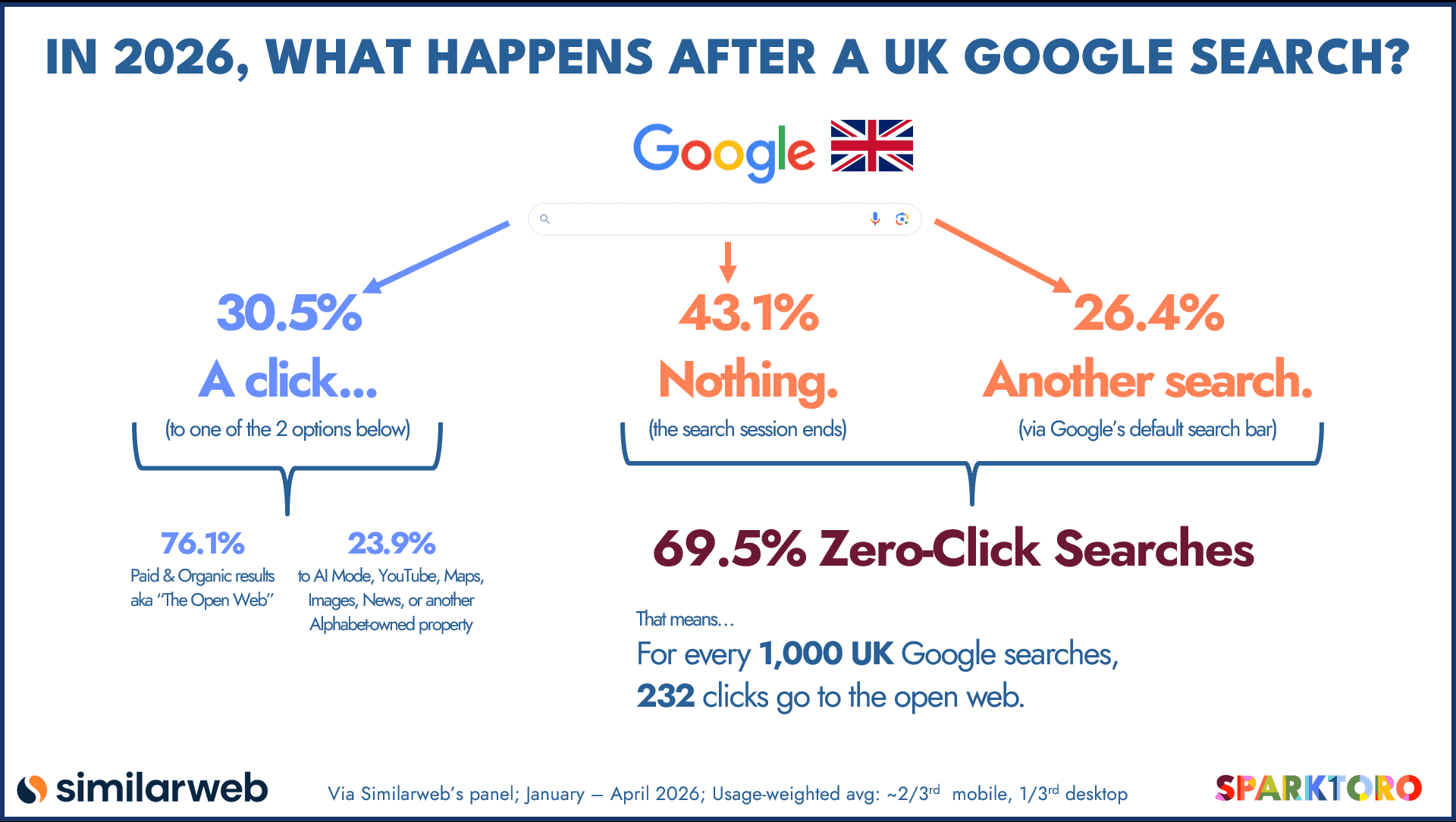
Top Zero-Click Search Statistics
- 69.5% of UK Google searches end without a click. (Source: SparkToro & Similarweb)
The central theme of SparkToro & Similarweb’s research focuses on the zero-click experience. Their data shows that more than two thirds (69.5%) of UK Google searches end without clicking through to another website. 43.1% of users end the session after their first search, while 26.4% submit another search within Google.
- 68.0% of US Google searches end without a click. (Source: SparkToro & Similarweb)
The US data gathered by SparkToro & Similarweb provides similar results to the UK element of the study. 68.0% of US Google searches now end without the user clicking through to another site; 39.0% of sessions close after one search, while 28.7% lead to another search within Google.
- Only 232 visits reach the open web for every 1,000 Google searches in the UK. (Source: SparkToro & Similarweb)
SparkToro & Similarweb’s UK study found that less than a quarter (23.2%) of Google searches result in the user visiting an external website. This means that, on top of the 69.5% of sessions ended without a click, another 7.3% of users click through to another Alphabet-owned site.

- Zero-click searches in the US increased from 60.5% in 2024 to 68.0% in 2026. (Source: SparkToro & Similarweb)
The US study shows a clear trend towards zero-click search in recent years, as it develops from an emerging trend into the dominant search behaviour. In 2024, just over 60% of US Google searches were zero click. By 2026, it had risen to 68% – an increase of 12.4% in just two years.
- The UK recorded the highest zero-click rate across the six countries analysed. (Source: SparkToro & Similarweb)
SparkToro & Similarweb’s research shows that the trend towards zero-click is particularly noticeable in the UK. Of the six countries studied*, the UK has the highest zero-click rate (69.5%). The country with the lowest zero-click rate is Germany, at 62.0%.
*Canada, France, Germany, Italy, the United Kingdom and the United States.
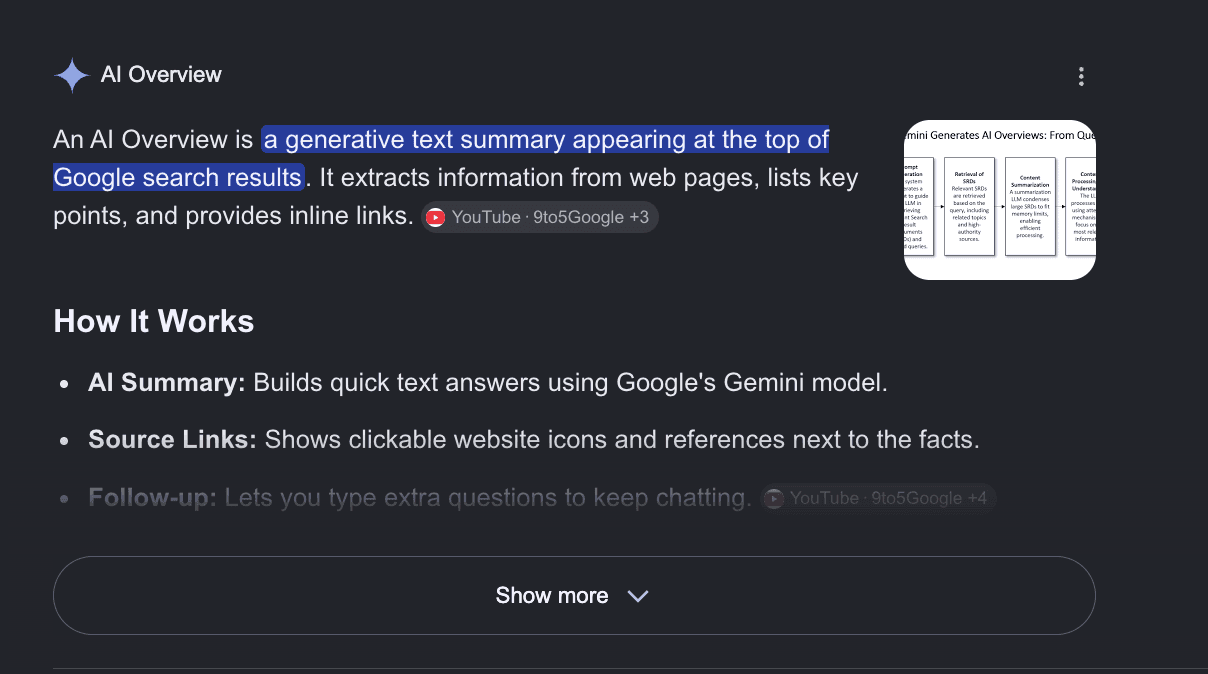
AI Overviews are changing click behaviour
The research from SparkToro & Similarweb highlights a fundamental change in how people search, and a key recent driver of this shift is the introduction of AI Overviews. Where Google once responded to searches by presenting a list of relevant links, it now provides AI-generated summaries that can directly answer queries, reducing the need for additional clicks.
Further studies back up this trend, showing a clear drop in clicks when an AI Overview is presented:
- Users clicked a traditional search result just 8% of the time when an AI Overview appeared, compared to 15% without one. (Source: Pew Research Center)
Pew Research Center’s study of the impact of AI Overviews shows that click-throughs to an external website are cut by almost half (46.7%) when one appears. Fewer than one in ten searches (8%) lead to a click if an AI Overview is provided.
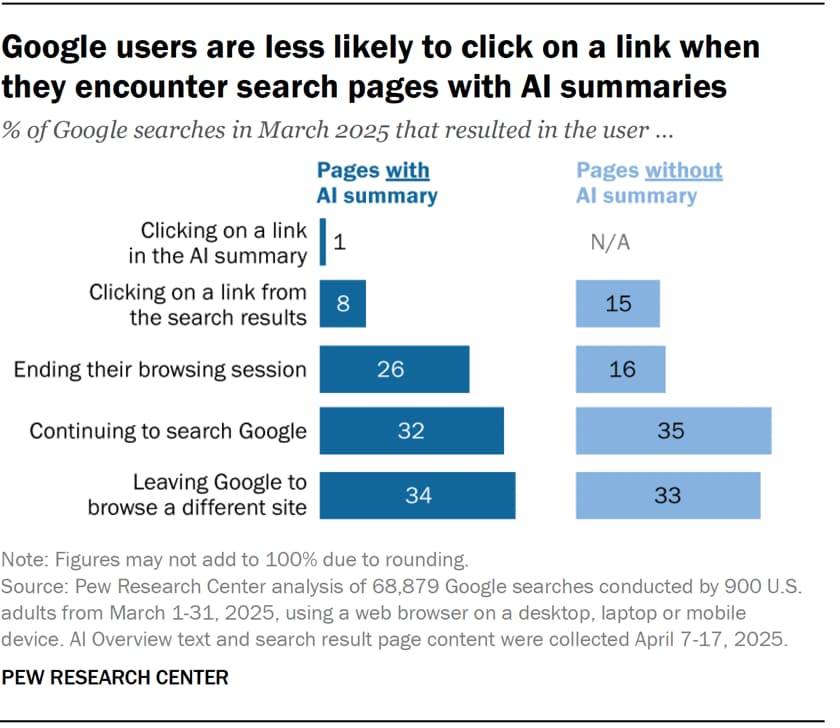
- Only 1% of users clicked a source cited inside an AI Overview. (Source: Pew Research Center)
Google’s AI summaries often include links to further information and sources – but users very rarely engage with them. Pew Research Center found that only 1% of users click on links provided in the AI Overview itself.
- 26% of users ended their browsing session after seeing an AI Overview, compared to 16% without one. (Source: Pew Research Center)
According to Pew Research Center’s research, just under one in six (16%) users end their browsing session entirely after visiting a search page. This jumps to over a quarter (26%) if the search results include an AI Overview – an increase of 62%.
- AI Overviews were associated with a 58% reduction in CTR for the number one ranking. (Source: Ahrefs)
Ahrefs’ research found that the organic clickthrough rate (CTR) for top-ranking pages dropped by 58% when an AI Overview was shown, over a two-year period up to December 2025.

- Position one CTR fell from around 7.3% to 1.6% for keywords triggering AI Overviews. (Source: Ahrefs)
The study by Ahrefs shows that clickthrough rates reduce even further for keywords where Google displayed an AI Overview. Top-ranking pages showed a 78.1% drop in CTRs for these queries.
The effect this has had on SEO is clear: ranking well is no longer a guarantee of traffic, because even the top-ranking pages are increasingly superseded by Google’s own summaries. The knock-on effect is that ranking well is a less valuable metric than it used to be, as users often have their questions answered before clicking on a link.
AI Overviews are expanding beyond informational searches
Initially, AI Overviews were primarily triggered by informational searches; a 2025 study by Ahrefs established that 99.9% of AI Overviews appeared in response to informational keywords.
That seems to be changing, though, as Google expands the feature to answer queries further down the funnel. A recent study from Semrush lays bare the rise in AI Overviews triggered by non-informational keywords:
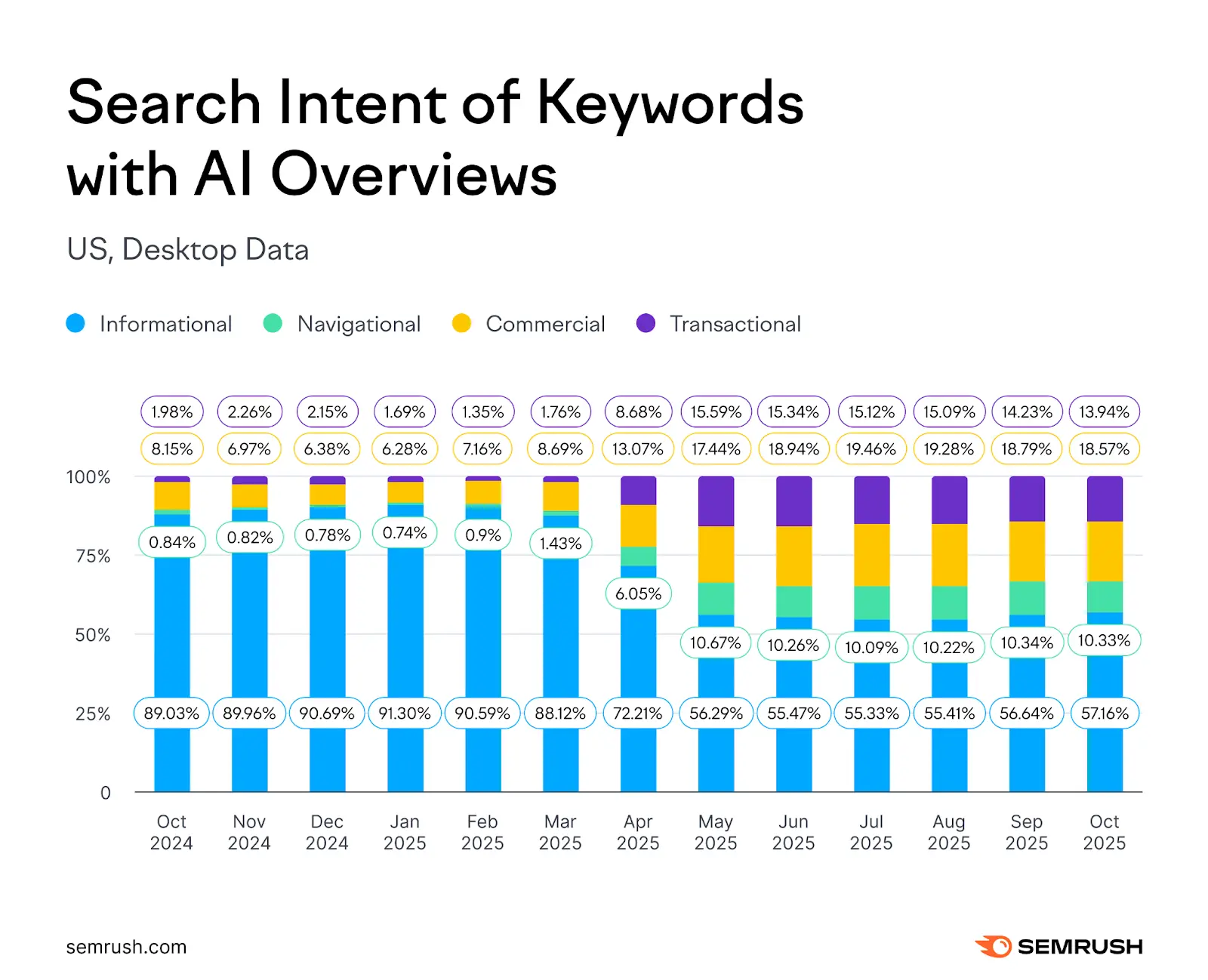
- AI Overviews appeared for 15.69% of tracked keywords (Source: Semrush)
Semrush’s research reveals that the percentage of overall queries that triggered AI Overviews increased sharply throughout 2025. In January 2025, 6.49% of queries triggered AI Overviews. By November 2025, that figure had more than doubled to 15.69%.
- Commercial keywords triggering AI Overviews increased from 8.15% to 18.57% (Source: Semrush)
While informational searches are still most likely to trigger AI Overviews, commercial queries are catching up; they went up from 8.15% to 18.57% from October 2024 to December 2025, an increase of 127%.
- Transactional keywords triggering AI Overviews increased from 1.98% to 13.94% (Source: Semrush)
Further down the funnel, you start to see much more significant shifts in how AI Overviews are triggered. Previously, only around one in fifty (1.98%) transactional keywords triggered an overview – that figure has jumped to almost one in seven (13.94%).
- Navigational keywords triggering AI Overviews increased from 0.84% to 10.33% (Source: Semrush)
According to Semrush’s data, navigational keywords are the most significantly impacted. They triggered AI Overviews in more than 10% of searches, compared to 0.84% previously – an increase of 1,130%.

- The share of informational keywords triggering AI Overviews fell from over 90% to around 57% (Source: Semrush)
All of these statistics come together to give a clear view of how AI Overviews have shifted to incorporate more commercial-oriented keywords. Informational keywords previously accounted for around 90% of AI Overview triggers; that figure has now dropped to 57%.
Again, we need to consider how this impacts SEO. Historically, the focus on informational keywords meant that the primary concern for SEO was the impact on blog traffic; the appearance of AI Overviews allowed users to get the information they wanted without clicking.
Now, though, the impact extends much further. As AI Overviews appear more often in response to commercial and transactional keywords, and traditional organic visibility declines, the concern switches from ‘will people read our content?’ to ‘will people even know we exist?’
Why zero-click search matters
The evidence makes it clear that a huge transformation in the nature of search is taking place, as the era of zero-click search develops. Pushing your website into the first page of search results is no longer enough, and this fact fundamentally changes how SEO should operate. That presents challenges, but also opportunities going forward.

Firstly, it is important to retain perspective. This is a significant change, but one that can be navigated with a flexible approach that covers the full search journey. Headlines declaring the death of SEO are wide of the mark – rankings still matter, they are just less central to effective SEO strategy than they used to be.
Clicks are now harder to earn, but that doesn’t mean that appearing in SERPs is not valuable. Maintaining visibility in AI Overviews and other SERP features is still a good way to increase brand awareness and influence customer decision-making.
The information brands present also takes on greater importance now – offering original data or insights that Google can’t easily replicate adds value, and can increase the likelihood of being cited within AI Overviews.
The changing landscape of search also makes digital PR a more valuable asset. Mentions and links from trusted websites strengthen the authority of the brand and signal to Google that it is a reliable source. Again, this may improve your chances of citation within AI Overviews.
As we’ve established, traditional rankings are now just one part of a wider search environment. Brands that can optimise not just for rankings, but AI Overviews and other Google SERP features, are better positioned to earn citations and enhance their visibility.
As SEO strategies change, the metrics used to assess them will evolve. Traditional metrics like website traffic and rankings only give one part of the picture of modern search, and a broader range of indicators should be considered. Overall search visibility, branded search demand and commercial outcomes will all play a bigger role in assessing a strategy’s effectiveness.
What brands should do next
This article has covered the changes in search over recent years, and discussed what it means for the future. But what practical steps can businesses take? We’ve put together a list of practical actions that can help to ensure your brand is well optimised across the spectrum of features, as you navigate the modern world of search.
- Create original content that gives users a reason to click. By design, AI Overviews provide short, simplified answers to queries. Providing more detailed advice, tools, infographics and data can encourage clicks beyond the AI Overview.
- Build authority through digital PR. Backlinks from trusted websites signal to Google that your brand is a reliable source for citation.
- Optimise pages for AI Overviews and Featured Snippets. Structure your content so that it is easy for Google to understand, with clear headings and concise answers to frequently asked questions.
- Measure visibility alongside traffic. As search pivots away from traffic and towards wider visibility, track the frequency of your brand appearing in Google’s SERP features.
- Provide unique first-party research and insights based on industry experience and expertise. These are more difficult for AI to summarise coherently, which may improve your chances of citation.

As zero-click becomes the primary search behaviour, brands can no longer measure success by the number of clicks. Modern SEO requires a more versatile, agile approach, and brands need to maximise visibility and influence across a broader range of search experiences in order to remain effective.
If you want to build a multi-layered SEO strategy that covers visibility across AI search, Google AI Overviews, zero-click search and GEO, get in touch with Kaizen today!

 Substack
Google’s Universal Cart, sheep-powered billboards & more
 Substack
Google reimagines Discover, Meta launches Muse Wonder & more
 Free Resource
Reddit Will Bury You In Downvotes – How to Win Visbility Without Posting
 Free Resource
TikTok SEO – How to Do It Right
 Substack
Gemini finally tracks its traffic, OpenAI watermarks its words & more
 Substack
Meta debuts Muse charm, YouTube announces Custom Feeds & more
 Substack
Anthropic Opus 5.5 launch, Fat Bear Week & more
 Free Resource
The Reddit Guide to UK Retail Audiences
 Free Resource
Reddit Masterclass – Webinar Recording
 Free Resource
LLM Masterclass – Webinar Recording
 Free Resource
How to Build a TikTok SEO Strategy – Webinar Recording
 Free Resource
How to Build a TikTok SEO Strategy
 Free Resource
How to Measure & Optimise LLM Performance
 Free Resource
The TikTok Shop Playbook for eCommerce Brands
 Free Resource
How to Scale LLM Traffic & Visibility


