

 SEO
SEO Digital PR
 GEO / AI Search
 Social

TikTok SEO Statistics 2026

Kamile Kupryte
Marketing Manager
Share
this article


TikTok’s evolution from an entertainment-first platform into a powerful search and discovery engine has been highlighted in a range of new studies. The research reveals that consumers are increasingly using the app to get advice, product recommendations and reviews, and make purchases.
Long dominated by Google, the search landscape has become much more fragmented in recent years. Consumers are increasingly turning to platforms like TikTok (and Reddit, YouTube and AI search) when looking for recommendations, reviews and inspiration, and this presents an opportunity.
Forward-thinking brands can enhance visibility and discoverability, drive organic traffic and reach high-intent consumers by looking beyond traditional SEO and introducing a dedicated TikTok SEO strategy at the centre of a modern approach to search.
Top TikTok SEO Statistics
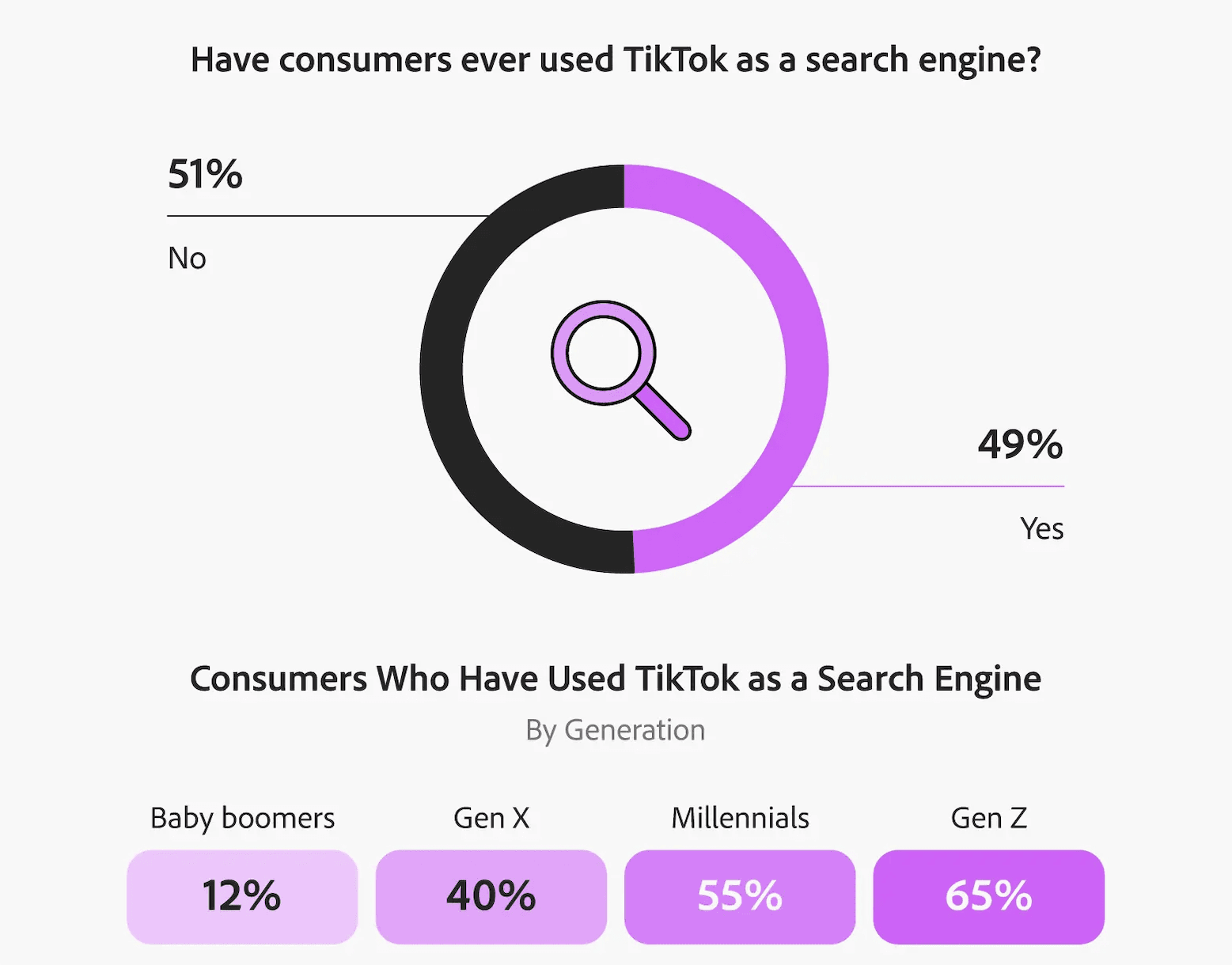
- 49% of consumers use TikTok as a search engine, up from 41% in 2024. (source)
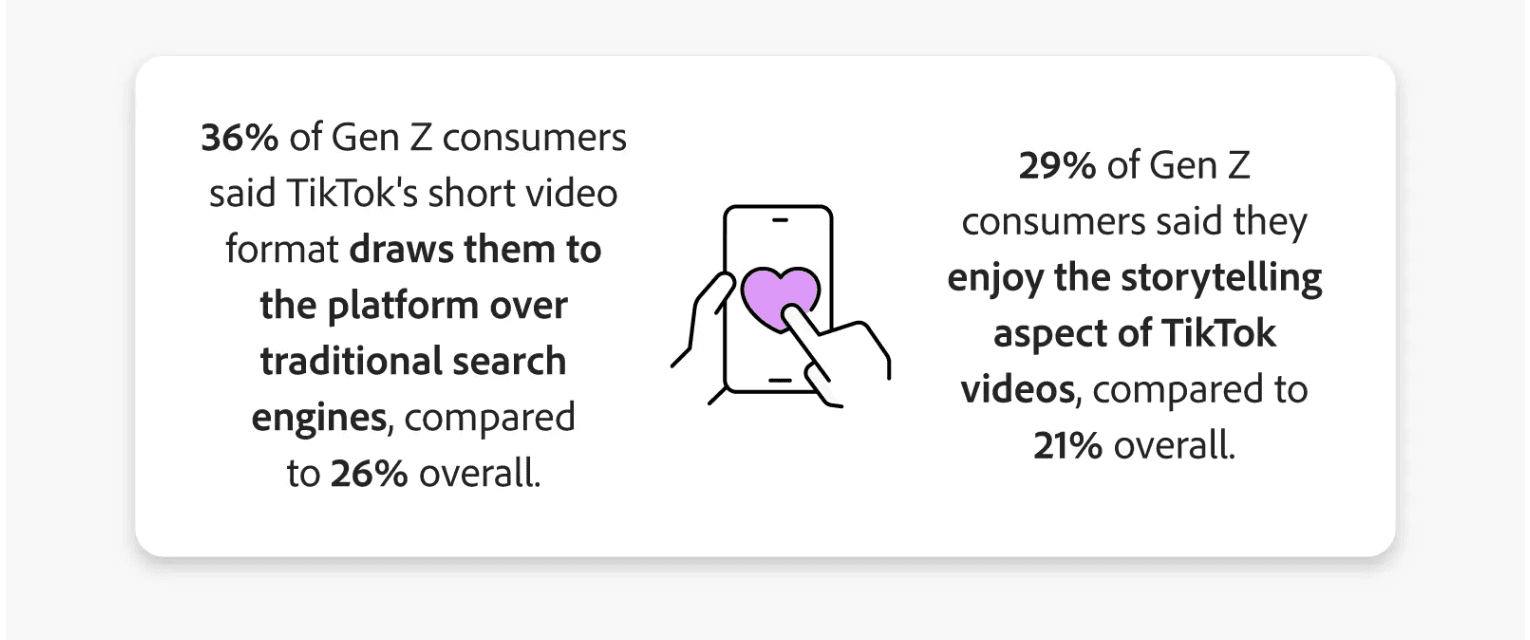
A survey commissioned by Adobe Express shows that almost half of US consumers (49%) now use TikTok as a search engine, citing the platform’s short video format, storytelling and interactivity as key features. This is up from 41% in 2024 – an increase of 19.5% in two years.
- 64% of Gen Z have used TikTok as a search engine. (source)
According to a study undertaken by Kaizen, almost two thirds of Gen Z have used TikTok as a search engine, again underlining the platform’s value as a search and discovery tool, especially among younger audiences with future spending power.
- 61% of TikTok users have discovered new brands and products on the platform – 50% more than other platform users. (source)
TikTok’s Marketing Science Global Retail Path to Purchase research reveals it is more effective than its competitors at supporting discovery, with 61% of users discovering new brands or products through the platform. TikTok offers three routes to discovery – swipe, tap and search – making it easier for brands to connect directly with consumers.
- Half of TikTok users have used TikTok to research or learn more about new brands or products. (source)
The Marketing Science Global Retail Path to Purchase study also shows TikTok’s increasing importance as a research resource, with half of users actively researching new brands and products on the platform – actions traditionally associated with Google.
- 91% of TikTok users who were inspired into action by a TikTok search reported following through and performing the action. (source)
The Marketing Science Global Retail Path to Purchase study also identifies a pattern of turning discovery into measurable actions, with nine out of 10 users reporting that their TikTok searches inspired actions such as further product research, brand website visits and making purchases.
- 61% of users reported that TikTok search results are more likely to inspire action than other platforms. (source)
TikTok’s Marketing Science Global Future of Search Study emphasises the platform’s impact, with 61% of users saying that they were more likely to be inspired into action by TikTok’s search results than by other platforms. This suggests that – unlike traditional channels – inspiration is a measurable commercial outcome on TikTok, evidenced by users taking meaningful steps as a result of TikTok search.

- One in five TikTok users have made a purchase as a result of information discovered through searching on TikTok, either on TikTok Shop or the brand’s site. (source)
The TikTok Marketing Science Global Future of Search Study also shows TikTok search’s ability to drive consumer action, with 20% of users reporting that they made a direct purchase via TikTok Shop or the brand’s site having found information through searching on TikTok.
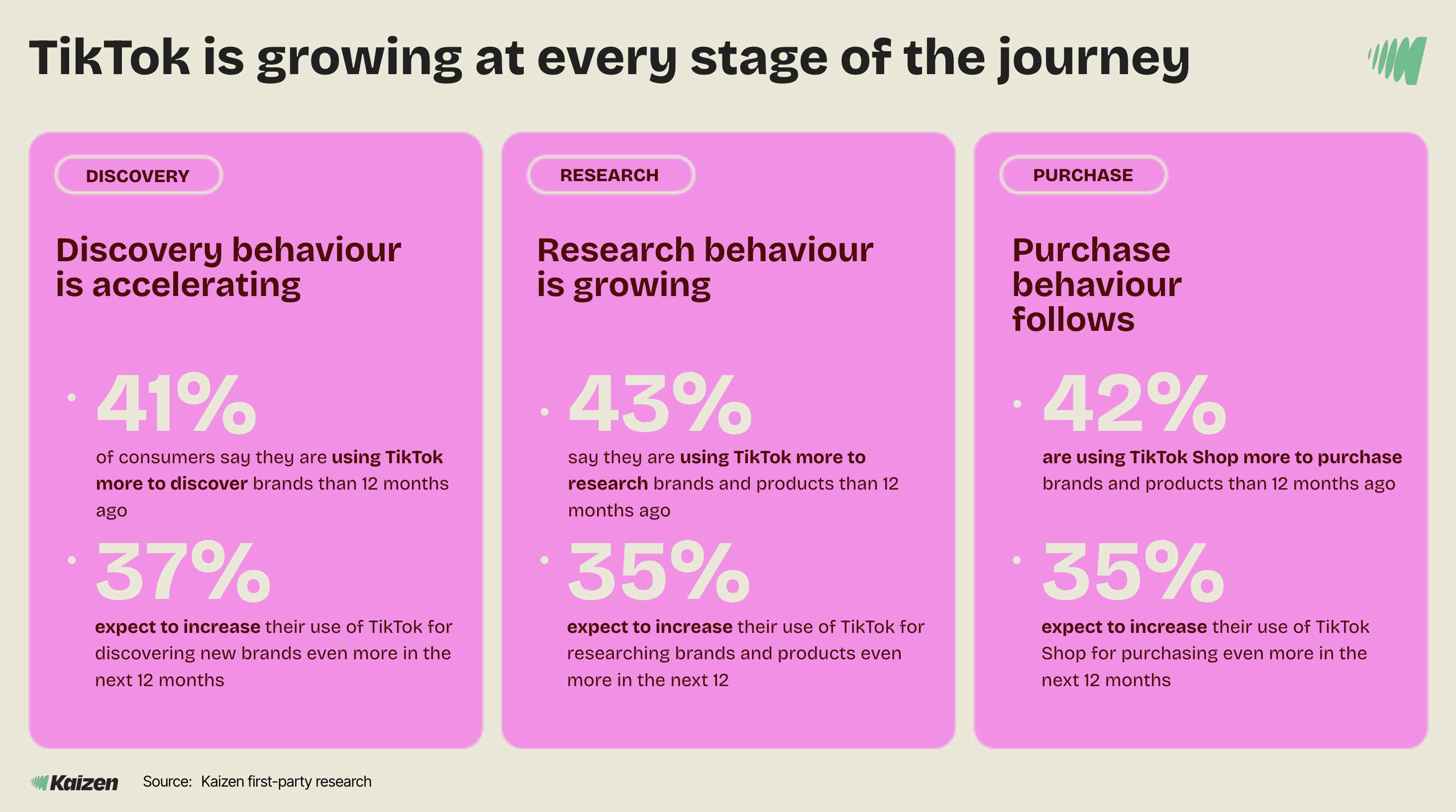
- 43% of consumers are using TikTok to research brands and products more than they were 12 months ago, 41% of consumers are using TikTok to discover brands more often than they were 12 months ago, and 37% say they expect their use of TikTok for discovery to increase in the next 12 months. (source)
Kaizen’s How To Build a TikTok SEO Strategy research reveals an ongoing evolution in consumer search behaviour, with users increasingly finding information about products and brands through TikTok. 41% of consumers report an increase in their use of TikTok to discover brands over the past 12 months, and 37% say they expect to use TikTok for discovery more often in the next 12 months.
The data also shows an increase in usage of TikTok for researching brands and products, with 43% of consumers saying they are using it more often than 12 months ago.
TikTok: the new discovery engine
When the internet first became an everyday part of life, search engines became the default gateway for finding information online, providing an entry point for people to discover brands and products. Whether you wanted to book a holiday, buy a pair of shoes or sign up for a new phone contract, search engines were the obvious starting point. That conventional wisdom held until the mid-2000s, when the emergence of social media introduced a new route to discovery.
Search engines continued to serve intent-driven discovery, providing a platform for people to search for specific things they wanted. Social media served interest-driven discovery, as users discovered brands and products through friends, influencers and trending content on their social media feeds.
These two channels have historically served distinct purposes in the consumer discovery process, with limited overlap – but research conducted by the platform suggests that TikTok is redefining the traditional funnel of discovery by supporting multiple stages of the customer journey. Three-quarters of shoppers identify the platform as the go-to place for discovering new brands and products, often before searching on Google.

According to TikTok’s Marketing Science Global Retail Path to Purchase, 61% of users say they have discovered new brands and products on the platform (50% more than users of other platforms), while research by Kaizen shows that 41% say they are discovering more brands on TikTok than 12 months ago and 37% expect this pattern to continue over the next 12 months. In fact, Kaizen’s study shows that TikTok is the leading discovery platform for both Fashion & Beauty and Food & Drink.
Rather than TikTok discovery being confined to passive scrolling, users are increasingly using the platform to research related products, watch product reviews and validate their purchase decisions (the GWI Social Media Statistics study reports a 71% increase in people using TikTok to follow or find information about brands) – whether the journey began with passive scrolling or active searching. As a result, some consumer journeys now take place entirely within the platform, while others begin on TikTok before consumers turn to search engines like Google.
TikTok: the new research engine
TikTok’s increasing value as a discovery engine is matched by its impact on the way consumers research products. Kaizen’s study establishes a similar pattern, with 43% of those surveyed saying they used TikTok to research brands and products more than 12 months ago, and 35% saying they expect this to continue over the coming year. These findings are backed up by TikTok’s own research, which reported that one in two TikTok users use the platform to research new brands and products.
These statistics underline TikTok’s status as a reliable and trustworthy platform for validating purchase decisions – a position traditionally dominated by Google Search. The data suggests that consumers view TikTok as a source of genuine opinions, first-hand experience, creator recommendations and product demonstrations – key factors when researching purchase decisions.
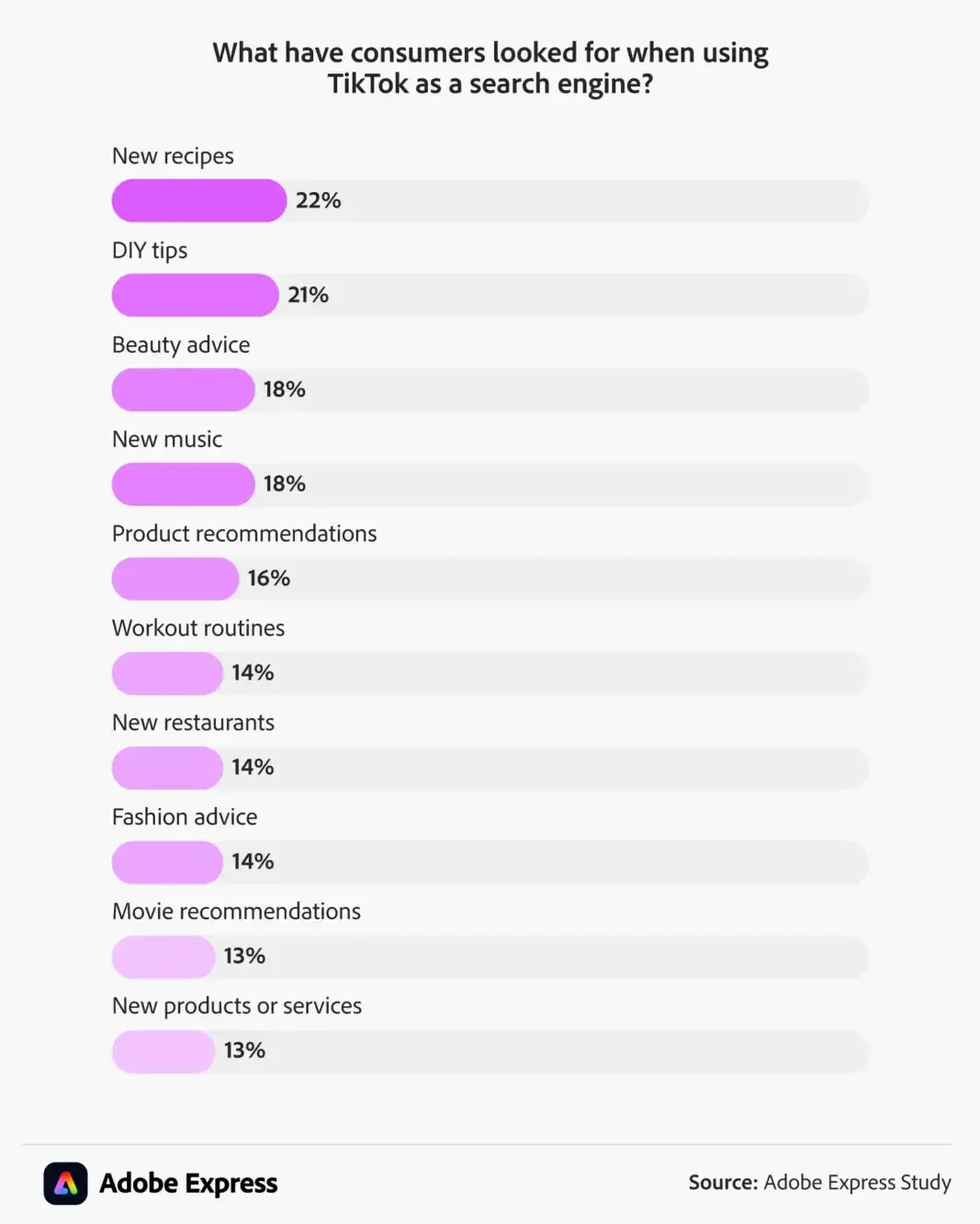
In terms of broader search sentiment, TikTok’s study found that 70% of TikTok search users find the platform’s search results more engaging and entertaining than other platforms, while a study by Adobe Express found that TikTok search users were most likely to prefer video tutorials, followed by product reviews, personal stories and influencer recommendations – tallying with the perception of the platform as focusing on those areas.

TikTok’s increasing influence on purchases
So, we know that TikTok has developed into a platform where consumers both discover and research new brands. But does this translate into tangible commercial outcomes? Research suggests that it does.
TikTok’s evolution from entertainment channel to commerce platform now spans the entire pathway from initial discovery right the way through to purchase, and influences consumer decision-making throughout the journey. Kaizen’s study shows that 42% use TikTok Shop more than they did 12 months ago, while 35% expect their usage of the TikTok Shop to increase further over the next 12 months.
TikTok’s own research appears to support this. According to the company’s TikTok Marketing Science Global Future of Search Study, one in five TikTok search users have made a direct purchase (via TikTok Shop or the brand’s site) after finding information by searching on TikTok. The TikTok Marketing Science Global Retail Path to Purchase study backs this up, showing that TikTok users are 50% more likely to discover a product on the platform and immediately purchase it.
The bottom line is this: TikTok Shop’s global GMV (gross merchandise value) for 2024 was $33.2 billion, more than doubling year on year. In the US this was even more pronounced – growing 650% YOY to $9 billion. This underlines how TikTok search visibility can directly impact revenue throughout the consumer journey – and that gives TikTok SEO real commercial value.
What are people searching for?
Historically, social media has tended to be algorithm-focused, with content aimed at hitting trending topics – but TikTok is at the vanguard of a shift in approach. Going viral with a fun meme might draw attention, but that doesn’t necessarily satisfy user intent. According to multiple studies, what consumers really want is answers to the recommendation-led, intent-driven questions they’re asking.
In essence, consumers are looking for the efficiency of a search engine, but with a personal touch. They want real answers to real questions, presented in the language of social media: research by Adobe Express shows that consumers value short video tutorials, product reviews, interactive experiences and personal stories. The TikTok Marketing Science Global, The Science of Search on TikTok study underlines how they like this content to be presented, emphasising users’ preference for content delivered in concise, entertaining and authentic ways.
Kaizen’s How to Build a TikTok SEO Strategy study supports this assessment. Popular searches tend towards lifestyle topics – the most commonly searched topics are recipes (36% of users), music (35%), DIY (34%), fashion (30%), workout routines and beauty advice (both 29%).
How TikTok SEO differs from Google SEO
Having established what consumers need, and understood that they use TikTok search to satisfy this need, you can begin to design an SEO strategy that optimises your brand’s TikTok.
First, it’s important to recognise that traditional keyword optimisation practices that have proven effective on search engines like Google cannot be imported to TikTok wholesale – while keywords are still used on TikTok, they are just one part of the puzzle.
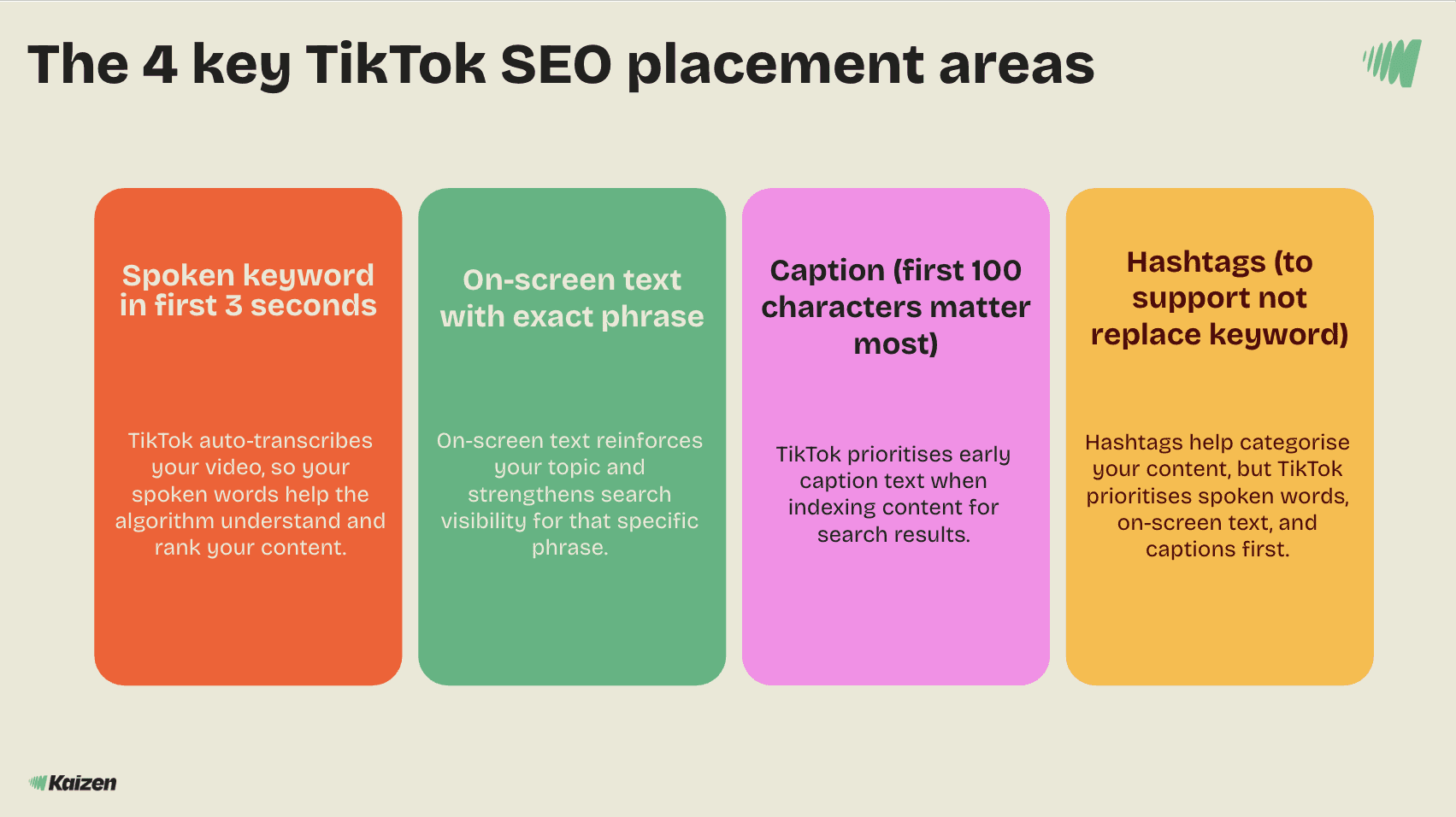
Successful TikTok SEO strategies can be split into two broad categories, relevance signals and engagement signals. Relevance signals are elements of the content that help TikTok to determine whether the video matches query intent, for example:
- Spoken language: speech recognition software recognises keywords and phrases e.g. ‘the best running shoes’.
- On-screen text: displayed text can be understood by TikTok to assess the video’s relevance, and lets users know whether it is what they are looking for.
- Captions: as with on-screen text, this can be assessed by both TikTok and users to establish relevance through identifying keywords.
- Hashtags: allows content to be categorised more easily, connecting it to related topics and aligning it with user hashtag searches.
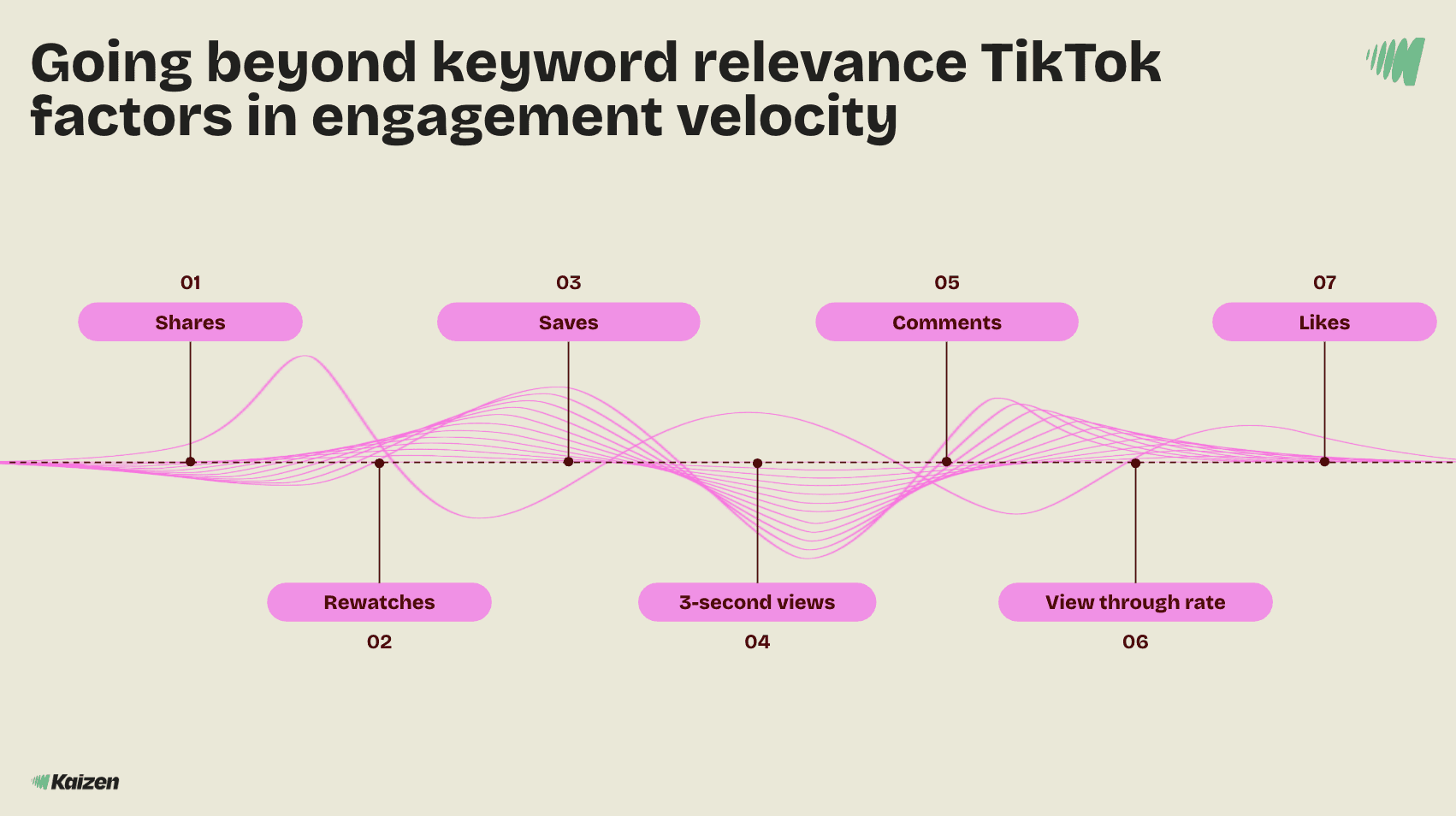
Engagement signals are measurable data points that help TikTok understand whether the content satisfied search intent. Examples include:
- Likes: indicates that the user had a positive response to the video (although this does not necessarily prove that it satisfied search intent).
- Engagement velocity: the speed of engagement with a video after publishing (high engagement velocity indicates high value or relevance).
- Comments: indicates that the user had a strong response to the video (although this can be positive or negative), indicating relevance that is reinforced by follow-up comments.
- Shares: indicates that the user found the video valuable enough to share with others.
- Saves: indicates that the user not only found the video useful, but plans to revisit it – especially useful with informational content, implying that revisiting may lead to action.
- Watch time: if a user watches all or most of a video, it can be inferred that the content was useful.
- Rewatches: indicates high relevance or value.
- Actions after viewing: indicates that the user is progressing through the purchase journey (e.g. a purchase directly after viewing a product on TikTok).

What brands should do next
The evidence suggests that TikTok SEO should be a priority for brands going forward. Here are some practical steps your company can take to implement TikTok SEO as a central part of its organic search strategy:
- Research TikTok search intent: study autocomplete suggestions, popular videos and comments to identify why the user is searching for something and what they want to find. This allows you to focus your content on matching the user’s intent.
- Create search-first content: reverse the creative process; instead of starting with an idea and hoping users discover it, create content based on things that users are already searching for. Although the best content often has both, your content’s usefulness is more important than its entertainment value.
- Optimise spoken and written keywords: as mentioned above, keywords haven’t been discarded – they are just integrated across a broader range of content types. TikTok analyses spoken language, on-screen text, captions, hashtags and video descriptions, providing multiple opportunities to signal relevance.
- Build content around recurring questions: user questions in searches and comments indicate existing demand – satisfy this demand by creating content that answers the questions that come up regularly.
- Use tutorials, reviews, comparisons and recommendations as core formats: search-driven content of these types that directly answers user queries tends to perform well, aligning with commercial and informational search intent.
- Measure search visibility rather than vanity metrics: while views, likes and follows look good, they don’t necessarily tell you how your content is being discovered or drive useful outcomes. Instead of these ‘vanity metrics’, focus on less glamorous metrics that provide long-term organic performance, like search-driven visibility, search-generated views, keyword ranking, click-throughs and conversions – that’s where the real value is.
- Review TikTok comments and search suggestions for keyword and content ideas: comments and search suggestions can be instructive in relation to users’ questions, providing additional detail that offers opportunities to broaden your scope while still targeting specific queries.
- Test multiple hooks against the same keyword cluster: create multiple versions of the same content, but with different hooks targeting keyword clusters; this can give you insight into what content formats resonate with both users and the TikTok algorithm.

TikTok’s increasing influence on digital discovery marks one of the biggest challenges ever posed to traditional search engines like Google. The evidence shows that consumers are increasingly using the platform to discover and research new brands and products and make purchase decisions, effectively transforming TikTok into a modern search platform.
The evidence indicates that this is not merely a passing trend, but a fundamental shift in how consumers discover information, research products and make purchasing decisions, and that presents an opportunity for brands. By adopting a dedicated TikTok SEO strategy, brands can optimise their TikTok content to maximise relevance and engagement signals, resulting in increased visibility, more targeted focus on high-intent users and improved commercial outcomes.
To learn how Kaizen can support you in designing a TikTok SEO strategy tailored to your brand’s needs, you can download our ‘How to Build a TikTok SEO Strategy’ guide, or request a free brand audit here!


 Substack
Why Good Brand Messaging Still Makes Bad Social Content
 Substack
Google expands AI Overviews, Apple Maps gets ads & more
 Substack
Interactive tools in AI Overviews, YouTube vs Netflix & more
 Substack
Reddit is a Siren song in the age of AI search
 Substack
Gemini 3.7 Flash, AI-voiced Reddit posts & more
 Free Resource
The Reddit Guide to UK Travel Audiences
 Free Resource
The Reddit Guide to UK Retail Audiences
 Free Resource
The Reddit Guide to UK Education Audiences
 Free Resource
The Reddit Guide to UK Finance Audiences
 Free Resource
Reddit Masterclass – Webinar Recording
 Free Resource
LLM Masterclass – Webinar Recording
 Free Resource
How to Build a TikTok SEO Strategy – Webinar Recording
 Free Resource
How to Build a TikTok SEO Strategy
 Free Resource
How to Measure & Optimise LLM Performance
 Free Resource
The TikTok Shop Playbook for eCommerce Brands


